Saturday, February 12, 2011

Lab A revisted: Instruction Junction

This week in 255 we had the chance to try lab A again. This time around you could prepare to an extent of what you wanted to do and how you wanted to do it. Having the ability to watch yourself teach you can pick up on what you did well and what you need to work on.

Before we get into what i think you can watch the video for yourself below.


Now that you have seen my second attempt let me delve into what i take form it. Firstly what i did correct. I believe i spoke clear and loud so everyone could here me and never put my back to the students. I checked for understanding, demonstrated and spoke with my hands as well to further get my point across. I also did not cover to much information or say alright a million times like last time. lastly i never say uhm.

However there were some things i was disappointed in. For one there was not enough activity time only 40 percent of the time and that was largely due to my excessive instruction time which took 50 percent of my time.That is far to much in a physical education setting and is going to be my next thing to work on. I'm sure there are other things that i hope my peers can help me see so i can improve even further.

On the other hand i had fun participating in my fellow classmates lessons.

All in all another great chance i had to improve my teaching skills.

Here are links to my Time coding sheet and  Transcript.

Thursday, February 10, 2011

Chapter 2 Questions

This is my answers to the questions from chapter 2

Q3. What are the requirements for learning a motor skill? 
There are a list of requirements for learning motor skills. First the learner must have all the prerequisites in motor and physical abilities also developmental readiness. They must have a clear idea of how to perform the task and accurate motor program. Motivational/attentional disposition to the skill. There needs to be Practice. Finally make sure you give feedback.

Q3. What do each of these requirements mean for the teacher of motor skills?
For the prerequisites the teacher must do a task analysis to see what the prerequisites will be for the given skill. To full fill the clear idea of the task the teacher must make sure the students comprehend what is being asked and how they could do it. For the Motivational/ attentional  disposition to the skill the teacher must have original and exciting activities. Make sure there will be ample practice for skill development. The teacher needs to give feedback.

Q4. What is the difference between the way closed skills, open skills, discrete skills, and serial skills taught?

Open skilled should be taught by varying the environment because they are skills that do not take place in the same conditions. Closed skills are ones that take a place in the same environment and do not vary much so they should be taught in those settings. Discrete skills would be taught with few extra actions because they are quick and have a clear beginning and end. While serial skills are multiple skills in a row and would be taught with activities that would work on one part at a time and adds them together through more activities.

Monday, February 7, 2011

Chapter 1 question assignment: Take 2

After reading chapter one we were asked to answer some questions, not summarize the chapter. So without further ado here are the answers to before mentioned questions.


1. What is meant by the idea that teaching is a goal-oriented activity? When they say goal-oriented activity they mean that we have an objective in mind. we are at A and by the time classes are over we want our students to be at B, in the context of psycho motor, cognitive and affective domains. We teach our students with the goal of having them grow over the academic year and reach the standards we have in place whether it be state or national.

4. Why is the process that teachers choose to use content important? The process will change depending on the goals and content of the lesson. How you teach the given task needs to be molded to the actual task. For an example dribbling a basketball has certain freedoms to it. The space you have to dribble, the different ways you can dribble the ball, the time etc. Now a lay up in basketball has more of a proper technique to it. Can only be done on a hoop and a certain way. There is less space and freedom and can be harder to correct. So depending on what you are teaching changes how you are teaching it.

5. Why is the movement task-student response unit of analysis so important in physical education? It is important because it is the key to motivation and effective teaching. The movement task needs to be clear , understandable, and appropriate. The teacher has to be enthusiastic and able to get the students involved in the lesson. Then comes the student response, the teacher must build rapport and keep giving coherent instructions, that are on task, and flow together to keep the students involved. The teacher also needs to asses the students to give feed back to breed improvement and growth to work towards before mentioned goals.

Sunday, February 6, 2011

Teaching Basics For Physical Education: Chapters 1,4 and 5

Reading chapters 1, 4 and 5 of the text was just a refresher of what i have already learned through trial, lecture and experience. The chapters highlight the qualities one needs to be a successful physical educator. From getting attention to keeping it. Having age and skill appropriate tasks that are challenging and rewarding. From reading the chapters you can see just how many different areas one must cover. It may seem overwhelming but it is what this profession does everyday.

The pedagogy is essentially a PE cheat sheet. Ways and methods to get attention and way to engage the students. Also almost a checklist if you will. There are certain proven methods that have been used time and again, but when i read these methods i think of ways i can make them my own, adapt them.

 All the information in the chapters and pedagogy are a foundation and building block for teaching. By learning these basics you can start to adapt and develop your own style of teaching. It is important though to always remember the basics because they allow you to have more flexibility in your teaching, but can never be left out or you can fall into a poor learnign enviroment.

There are many factors to consider when it comes to teaching and at times it may seem overwhelming, but eventually it becomes more natural. However it never becomes automatic because teaching is always evolving so the educators must as well.

Wednesday, February 2, 2011

Snow Days; Another blow to fitness


When there are snow days in school every kid is full of excitement. No dull classes orsame routine. They do not have to get up early or get on the bus. I think of another side when i put my physical educator hat on. As in most school districts like mine PE is an every other day class. So on a snow day half the students miss there PE class which could be 1 of 2 for that week. If that is the only time that student gets physical activity it really makes our job that much harder. Where am i going with all of this you ask? A snow day just brings to mind more reasons why PE should be an every day class.

Its always the first to be sacrificed and always last in importance.We need more activity time and snow days just give us more reasons to do nothing. A stretch, possibly, but sometimes you have to look at the big picture. We need to cut down on things we can control that limit our activity because when its a snow day most people wont go out of their way to get that heart rate up. Also we can make winter activities seem more exciting. Snow shoeing, cross country skiing, meaning incorporate more things into your program.

Thinking of different scenarios and settings that you can mold lessons to can be a powerful thing. Students may decide to do one of the cool activities they learned in class that they can do in the snow or rain etc.

Just food for thought.

Tuesday, January 25, 2011

PED 255 Teaching Blindside

Well on the first day of 255 we had to teach a 5 minute micro lesson. To see how i did before i critique myself watch the video shown above.

First thing i will discuss is the things i did well. I spoke to the students making sure they could hear what i was saying. I spoke clearly and demonstrated what i wanted them to do. For the 2 minutes i had to prepare i had a pretty clear idea of what i wanted to try to do in order.

Now some things i believe i need to work on. I could have spoken louder and checked for understanding a few more times. I spoke clearly, but if it were younger students it i may have spoken to fast. I also could have had a little more energy.

See some stills of me in action below. Also if you want to see my transcript click here.

Wednesday, December 1, 2010

Last adventures of St Mary's

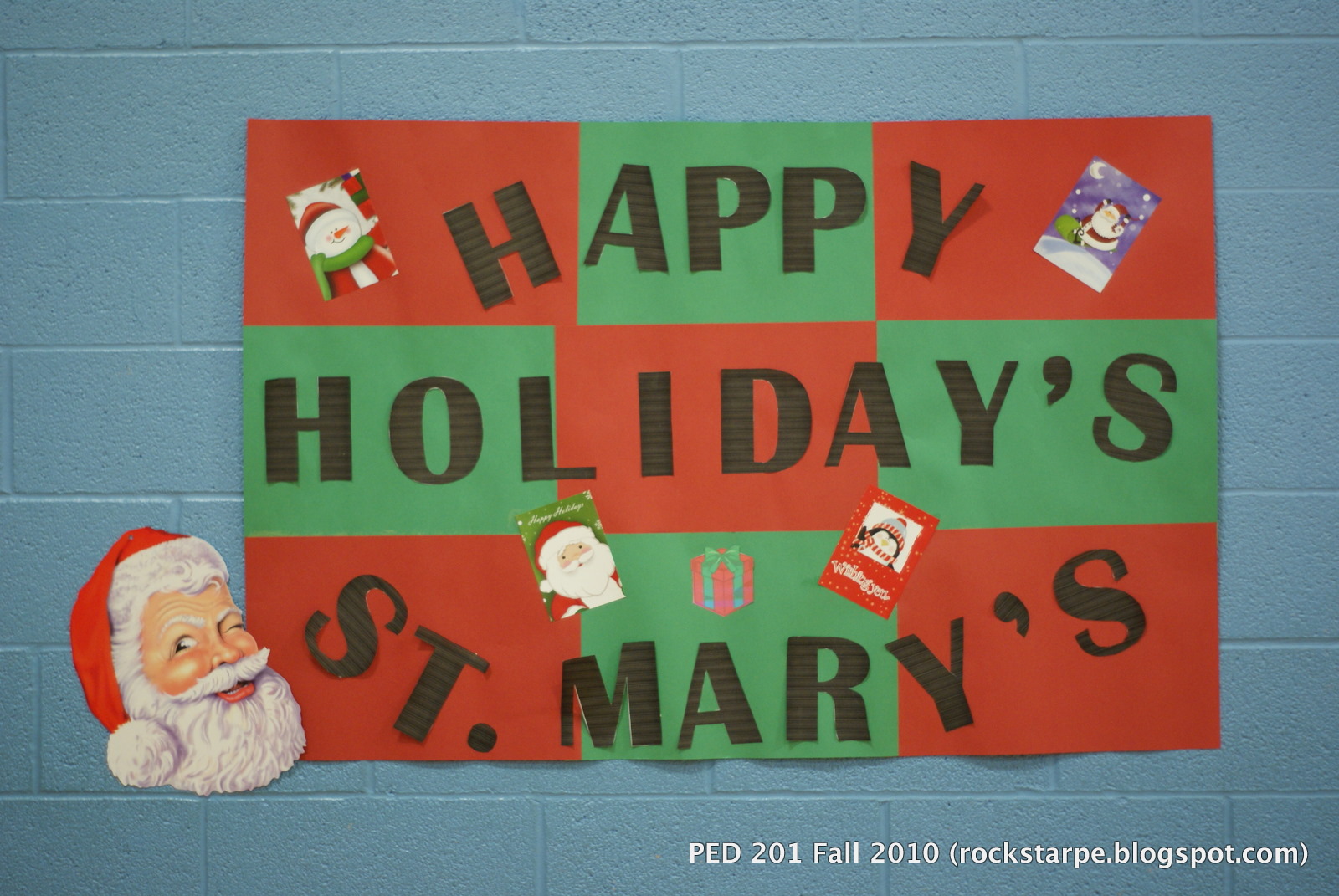
                         It was all about the holidays at St Mary's for our last visit. Santa and all his helpers were there playing with the kids. Elves were playing games others doing crafts and drawing pictures.

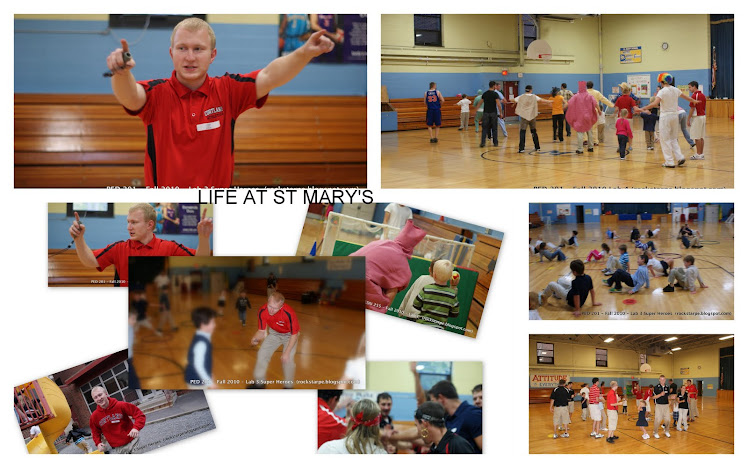
In my last trip to St Mary's i worked with all the age groups. I played with dinosaurs in the pre k, played tag ball with some older kids and everyone played capture the presents. We even had the parachute out for our last time which the students love.

I have learned a lot from my time at St Mary's and i thank the whole school for allowing me to be part of their time.I enjoyed working with the kids and will always remember it. So i say good bye to St Mary's and look forward to my next teaching experience and will use what i have learned to make myself and excellent teacher. 


What have i learned you ask?